
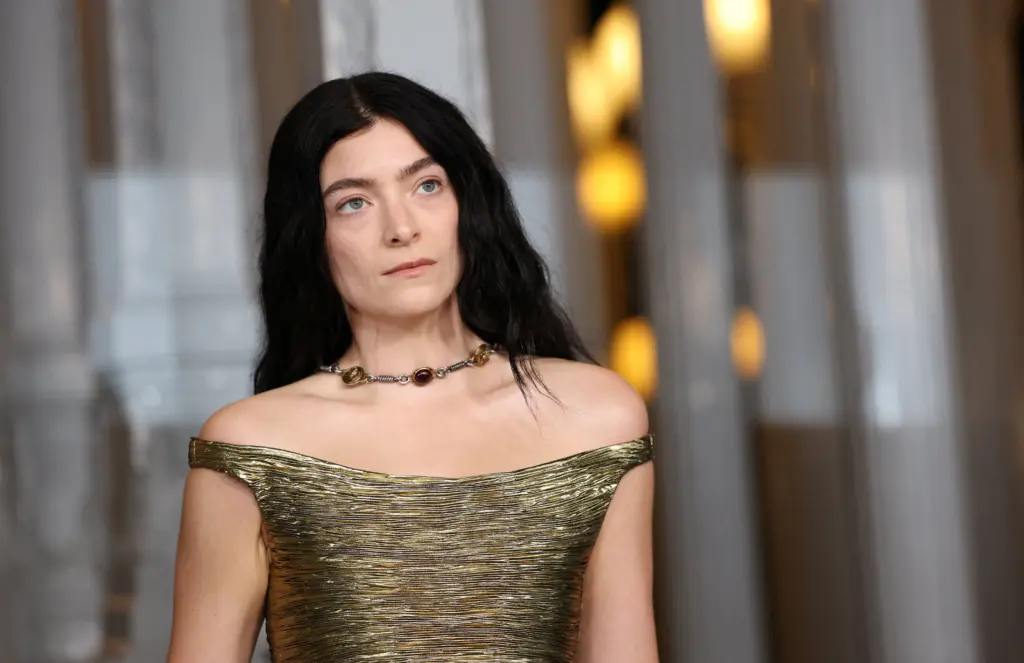
I shared the most intimate moment I witnessed this year with 20,000 other people. We were in a basketball arena in Philadelphia to see Lorde, at a concert built around her new album, Virgin, from which she would play every song before the night was over. But it was an older song that got the crowd to draw in its breath. The opening chords of “Liability,” from Lorde’s 2017 album Melodrama, were exciting enough; like the teenager standing next to me, many of the concertgoers clustered around us were probably already aware that it’s not one she plays every night. But she wasn’t playing it then, either—at least not yet.
The song, in which a young woman confesses to being simply “a little much” for the people around her, is built around a steady, descending piano part that sounds more like the skeletal framework musicians use to teach each other chord changes than a fully fleshed-out song. Listening to it feels almost like sitting next to the singer as she’s coming up with the song in real time, noodling away at the piano in the early morning hours, perhaps after the tear-streaked cab ride that opens the first verse. She’s just been broken up with, she tells us, and has come home to “the arms of the girl that I love,” which seems like a good enough place for her to be. But a few lines later, she admits there’s no such girl—or at least, that the only person whose love she can really manage is her own, and even that relationship can be a little stormy. “I do my best to meet her demands/ Play at romance, we slow dance,” Lorde sings, “But all that a stranger would see/ Is one girl swaying alone, stroking her cheek.”
On Virgin, Lorde sounds both more confident and more vulnerable than ever. As you might expect of a 29-year-old who had her first pop hit when she was 16, she’s been through the mill a few times over, and the album finds her struggling with issues like gender identity and an eating disorder, as well as the end of her roughly seven-year relationship with a music industry executive 17 years her senior. But what she’s struggling with most frequently is her own sense of self, and the way that the hypervisibility of contemporary fame has made it harder for her to see who she is. Mirror imagery runs through many of Virgin’s songs, but rather than reflect, they simply distort. On “What Was That,” the album’s introductory single, she covers up mirrors in a futile bid to actually see herself, and by “Broken Glass,” whose lyrics make reference to bulimia, she’s lashing out at her own image, the imperfect reflection that shows her perceived physical flaws without any hint of what’s underneath. “I wanna punch the mirror, to make her see that this won’t last,” she sings, as if the song is a way of stepping outside her own body, seeing herself in three dimensions instead of two. “It might be months of bad luck—but what if it’s just broken glass?”
I shared the most intimate moment I witnessed this year with 20,000 other people. We were in a basketball arena in Philadelphia to see Lorde, at a concert built around her new album, Virgin, from which she would play every song before the night was over. But it was an older song that got the crowd to draw in its breath. The opening chords of “Liability,” from Lorde’s 2017 album Melodrama, were exciting enough; like the teenager standing next to me, many of the concertgoers clustered around us were probably already aware that it’s not one she plays every night. But she wasn’t playing it then, either—at least not yet.
The song, in which a young woman confesses to being simply “a little much” for the people around her, is built around a steady, descending piano part that sounds more like the skeletal framework musicians use to teach each other chord changes than a fully fleshed-out song. Listening to it feels almost like sitting next to the singer as she’s coming up with the song in real time, noodling away at the piano in the early morning hours, perhaps after the tear-streaked cab ride that opens the first verse. She’s just been broken up with, she tells us, and has come home to “the arms of the girl that I love,” which seems like a good enough place for her to be. But a few lines later, she admits there’s no such girl—or at least, that the only person whose love she can really manage is her own, and even that relationship can be a little stormy. “I do my best to meet her demands/ Play at romance, we slow dance,” Lorde sings, “But all that a stranger would see/ Is one girl swaying alone, stroking her cheek.”
On Virgin, Lorde sounds both more confident and more vulnerable than ever. As you might expect of a 29-year-old who had her first pop hit when she was 16, she’s been through the mill a few times over, and the album finds her struggling with issues like gender identity and an eating disorder, as well as the end of her roughly seven-year relationship with a music industry executive 17 years her senior. But what she’s struggling with most frequently is her own sense of self, and the way that the hypervisibility of contemporary fame has made it harder for her to see who she is. Mirror imagery runs through many of Virgin’s songs, but rather than reflect, they simply distort. On “What Was That,” the album’s introductory single, she covers up mirrors in a futile bid to actually see herself, and by “Broken Glass,” whose lyrics make reference to bulimia, she’s lashing out at her own image, the imperfect reflection that shows her perceived physical flaws without any hint of what’s underneath. “I wanna punch the mirror, to make her see that this won’t last,” she sings, as if the song is a way of stepping outside her own body, seeing herself in three dimensions instead of two. “It might be months of bad luck—but what if it’s just broken glass?”
In concert, pop stars are surrounded by images of themselves. Their own faces stare back at them from t-shirts and line the merch tables, and even when they’re on stage, they’re surrounded by reflections, scattered across screens so that even people in the nosebleeds get a feeling of being close to the action. And though I grew up watching blurry, vaguely people-shaped dots on a stage, the thought of a concert without those screens now seems almost unimaginable. Attending a concert is now as much like watching a movie as it is about witnessing a live performance; the sophistication with which even mid-tier artists film their shows for the in-house audience puts many concert films to shame. And yet all those cameras and all those screens are rarely doing anything more complicated than showing the crowd what’s happening on stage.
Lorde’s “Ultrasound” tour, which will play its last American dates of the year at Brooklyn’s Barclays Center this Tuesday and Wednesday, is different. There’s a screen, all right, but only one, and it’s not hanging a hundred feet in the air, forcing everyone in the arena to choose between looking at it or looking at her. Instead, it’s stretched across the back of the stage, often serving as the only backdrop. The tour’s presentation is minimalist, with the band largely invisible at the sides of the stage and only a pair of dancers whose choreographed movements sometimes come off as almost a parody of pop-music spectacle. (During one song, one of the dancers eats an apple.) Lorde sometimes refers to her career as an “art project,” and although the tour’s stripped-down staging may have something to do with the commercial failure of her last album, 2021’s Solar Power, it’s used to tremendous effect, feeling at times more like a work of conceptual theater than a pop concert.
In particular, it feels like Kip Williams’ The Picture of Dorian Gray, which converted Oscar Wilde’s novel about narcissism into a one-person show by using onstage cameras and prerecorded video to allow a single actor to play more than two dozen roles. Conceived in Australia during the COVID lockdowns, the show’s approach may have been as much a function of necessity as anything else, but it proved a startlingly apt fit for a story about a person whose obsession with their own image leads to their ultimate destruction.
On Broadway, Sarah Snook, who won a Tony for the role, not only played the parts but frequently served as her own camera operator, at one point operating Snapchat filters in real time as Dorian’s attempts to modify his own looks turn his face into a yassified blob.
I don’t know if Lorde, who spent the early pandemic back home in her native New Zealand, was able to slip across the Tasman Sea in time to catch one of those early performances, but it seems likely someone involved with the tour did. Yet instead of falling prey to her own image, she confronts it. During “Broken Glass,” she pulls at her belt, reenacting a time when she might have counted how many notches she could pull it in, and at various stages in the show, both her jeans and her T-shirt come off, with only a few pieces of duct tape on her chest keeping her from exposing herself completely. During “GRWM,” she stands at a right angle to the audience in a tank top and a pair of boy shorts, hiking up her shirt so a dancer can film her midsection with a tiny camera. The belly she was once fixated on shrinking now stretches the entire width of the stage, dwarfing the two figures in front of it.
The gesture contains some of the staged ambivalence toward pop stardom that Lorde manifested during the tour for Melodrama, part of which she performed in a transparent box suspended above the stage, like a pet lizard in a terrarium. But the way she plays with these symbols feels more controlled now, more analytical than acting-out. After downsizing from arenas to theaters for the Solar Power tour, she returned to larger venues with a renewed sense of both purpose and gratitude. It’s as if she’s figured out how baring her soul and most of her body to thousands of strangers every night can actually heal her.
It all comes to a head with “Liability.” Or more specifically, the intro to the song, where, on the nights she plays it, it’s prefaced with a lengthy, unscripted monologue that’s unlike anything I’ve ever seen on a stage that size. If you see enough concerts, you learn that even the most apparently off-the-cuff moments are often carefully choreographed, and not just for pop stars whose elaborate spectacles have to be worked out far in advance. (Even Bruce Springsteen recycles the same canned patter show after show, although he’s an old pro at making it sound like he just made it up.) The savviest performers build in moments of micro-spontaneity, like Taylor Swift’s surprise songs or Sabrina Carpenter’s “Juno” positions, one-night-only occurrences that can propagate across social media and obscure the fact that the vast majority of their concerts are beat-for-beat the same. But I’ve watched dozens of “Liability” speeches, from Vegas and Seattle and Lodz, and while there are recurring themes, it’s striking how different they are, how purely in the moment. Lorde will talk about learning to accept her body, right down to the acne scars on her face, about how she steps on stage every night in the same T-shirt and jeans she wears on the street, maybe about a local bookstore she’s fond of visiting. And she’ll talk about how she never knew if she’d be able to play venues this size again, about how scary the world feels right now, and about how lucky we are to have this moment, together, in this place.
(Slate)


